

What's the Difference Between Project Based Learning and Doing a Project?
True confession: I was a high school history teacher who lectured too much. I was just starting out in my career in education and thought that was what I was supposed to do—cover the content. I was aided and abetted by the textbook (it might have been Triumph of the American Nation, which as you can tell by the title would be, shall we say, more controversial today than it was in the late 1980s) and the worksheets and tests that came along with it.
I tried, mind you, to liven things up with occasional discussions, debates, and activities, but mostly I remember my students desperately trying to copy down everything I said so they could spit it back on the test (and yes, I did include some open-ended questions, it wasn’t all multiple choice!). They often looked, well, sleepy. They liked me so they generally cooperated, but I still remember one student approaching me as the class was hurrying out the door and giving me feedback on my lecture style, saying, “Mr. Larmer, could you make your voice go up and down more?”
The Limits of Lecturing
Now, I know some teachers can deliver wonderful lectures that ignite young minds. That was not me, and even now it’s a small minority of teachers in U.S. classrooms. Although good teachers today find ways to mix things up more than I did, the pedagogy of lecturing is still all-too-prevalent. (And don’t get me started on the typical pedagogy at the college level, but that’s showing signs of cracking.)
I don’t blame teachers. That’s how they were taught, mostly, and the model of teaching-as-telling goes way back in human history. Local assessment systems and the traditional school culture of final exams or department-level expectations can also increase the pressure to “cover the content.”
Why Traditional Teaching Falls Short
What’s wrong with this picture? Let me count the ways this approach to teaching is problematic:
- It’s based on the belief that learning is like pouring knowledge into an empty head; it doesn’t reflect modern understanding of how the brain learns.
- It doesn’t reflect what actual historians or social scientists do.
- It doesn’t seem connected to the real world or relevant to students (not that it always has to, as they might define it, but it should at least be more meaningful).
- It doesn’t teach students to think critically or build other 21st century success skills.
- It doesn’t lead to long-term learning; students typically forget most of what they memorize for a test soon after it’s over.
- It’s all too often, as I admit about my own teaching, boring.
What’s a better alternative? Teaching methods that are the opposite of the above. This includes document-based questions lessons; using primary sources; Socratic Seminars; simulations; research assignments; and project-based learning (PBL), which I’m focusing on here.
And by the way, to my lecture-leaning colleagues out there… Don’t worry, there is still room in PBL for the occasional lecture (or even a textbook, as a resource but not a guide). You’re still an expert, and if an appropriate way to teach students the content knowledge they need for a project is partially through direct instruction, permission granted!
So that’s the “why”—now let’s look at the “how” to do PBL.
What PBL Is and Is Not
Many people hear “project-based learning” and think it simply means “doing a project.” It might be building a model of an Egyptian pyramid, making a poster about a historic event, or dressing up as Martin Van Buren for a “Presidents Day” event. It could be a bit more rigorous than that, for example, a written report on some topic connected to the unit. These “projects” are typically done at home, following directions given by the teacher.
That kind of project has been called (by me, borrowing from Ron Berger) a “dessert” project because it typically comes at the end of a curriculum unit, or maybe it’s a “side dish” that is assigned during a unit. It might be a fun assignment or at least a change of pace, but it’s not the “main course”—it’s not how the important content is taught. Students might learn something, so I’m not saying these are bad assignments with no purpose, but they’re not project-based learning.
In PBL, the project is what drives the learning of important content and skills. The project engages students and creates an authentic “need to know,” which motivates them to learn what’s needed for it. All of the instructions and activities to follow are for the purpose of completing the project. Here’s another good metaphor, borrowed from Kristin Devivo at Lucas Education Research: the project is the train’s engine, not the shiny red caboose.
To be the engine, a project should have, to some extent at least, each of the seven Essential Project Design Elements in the model for “Gold Standard PBL” which I co-developed at the Buck Institute for Education. This is true for projects at all grade levels, whether in history, civics, economics, geography, or any other social science.
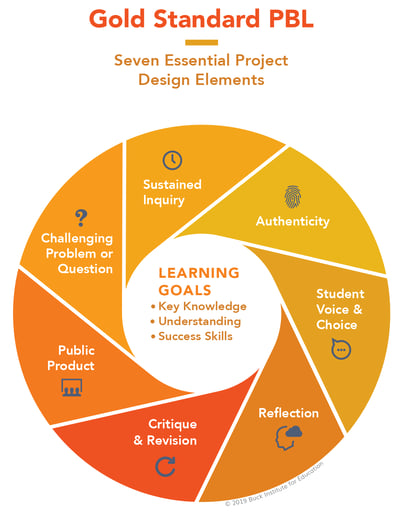
A note to teachers about the Essential Project Design Element of authenticity: simulations might be as authentic as you can get for certain topics/learning goals. Not all projects are fully “real-world”—which would be a tall order for, say, a history unit on ancient China. A project on more distant history is often more engaging—and authentic—if it can be connected to themes or issues that students would find relevant to today (although doing this might mean abandoning a chronological approach to history). For example, a project on why civilizations collapse could easily be linked to today’s world (if that’s not too scary!). It’s easier for a project about recent history to be fully authentic, as students can interview people who lived through the event or time period, find evidence of its lasting impact on their community, or tie local history to larger forces and changes.
Common Types of Projects
There are many possible ways to design projects. Here are examples of classic projects that can be done in social studies:
- A debate, speech, panel discussion, social media campaign, or multimedia presentation on a current event or controversial issue—the more local and personally relevant to students, the better.
- A museum exhibit about a historical time, place, person, event, or development.
- A proposal for a monument or memorial that explains a historical event or development.
- A simulation, role-play, or game that recreates a situation when people in the past, or in the present day, must solve a problem, make a decision, advise a leader, or take some sort of action.
- A podcast, guided tour, field guide, signage, or annotated digital map about local history.
- A civic action-taking or service-learning project to address a problem, benefit the community or the wider world.
- A piece of writing that addresses an issue or proposes a solution to a real-world problem, sent to someone in government, academia, a business, or a nonprofit organization.
Notice I did not list “PowerPoint presentation” about something students have researched. This is often a default idea for a project, and it has its place if designed well. But it can have problems, as you well know if you’ve sat through boring presentations filled with boatloads of information copied from a website, but no sign of critical thinking or creativity. Moreover, this kind of project might not have all of the Essential Project Design Elements, so it borders on being “dessert.”
For example, it doesn’t serve an authentic purpose, unless the presentation is meant to persuade a public audience in some way. And be sure it truly involves inquiry, with student-generated questions that spiral deeper and deeper, rather than being simply an exercise in looking up information. So design this kind of project so it meets the Gold Standard PBL criteria, and mix it up with other types of projects.
Buyer Beware
I’ll conclude with a note about being a smart consumer as a teacher looking for already-designed projects, which can be a great shortcut instead of designing them all yourself. These days, with PBL becoming more popular, you can find a lot of materials labeled “projects” that come from a publisher, curriculum provider, or other teachers sharing them online. When considering whether to use them, ask yourself: Is this a main course project or dessert (or the engine vs. the caboose, if you prefer)? Does this have all the Essential Project Design Elements? Can I add some Elements that are missing or need to be beefed up?
Go For It!
Those of you who are already using PBL know that it works when done well. If you haven’t tried PBL, I encourage you to. If you’ve been “doing projects,” redesign them so they better reflect the elements of Gold Standard PBL. And if you love to lecture, and can do it better than I could, remember you still can during a project—just not too much. Wait for the “need to know” moment, keep it short, and make sure your voice goes up and down!
About the author:
John Larmer is a project-based learning expert. In his 20 years at the Buck Institute for Education/PBLWorks, he co-developed the model for Gold Standard PBL, authored several books and many blog posts, and contributed to curriculum and professional development. He is now the Senior PBL Advisor at Defined and has written a forthcoming book on civic education for K-8 teachers.

Learn More About Career Connected Learning @ Defined
Discover how Defined Learning helps students build future-ready skills through project-based learning, STEM, and career exploration.